
Why Squats Hurt: What Most People Get Wrong About Strength, Mobility, and Pain
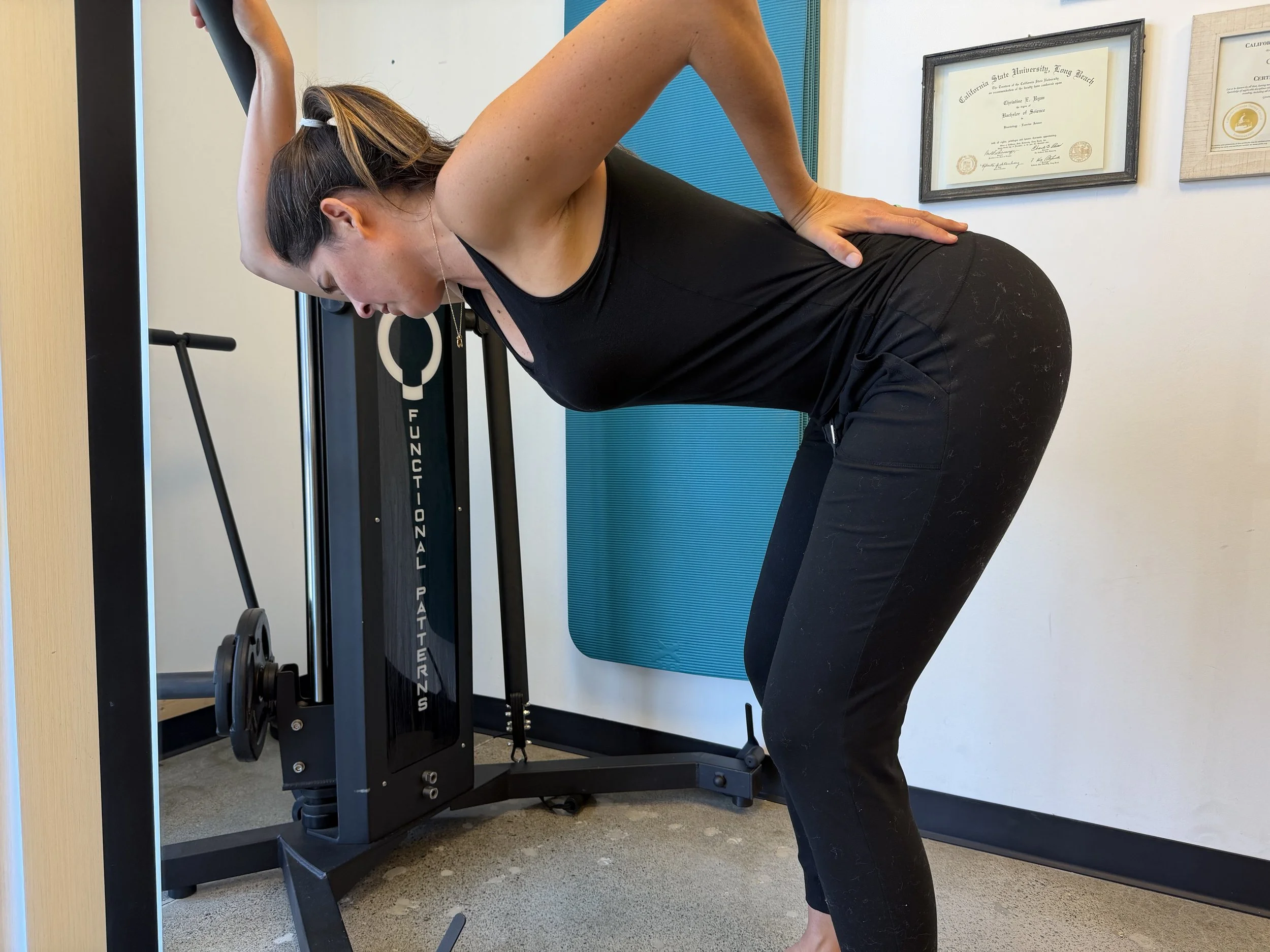
Most of the clients I see with knee or lower back pain during squats notice it starts in one of two ways.
Sometimes it’s sudden.
You feel good and go for a heavier weight or a personal record during strength training. Maybe you slept badly, felt stiff, were stressed, or hadn’t fully recovered.
Even if something feels a bit off, you still go for it. During a rep, you feel a tweak in your lower back or knee.
You take a break for a few days, hoping it will settle down, but every time you try squatting again, the pain returns.
Other times, it builds slowly. You finally stick to a strength training routine. You track your progress, focus on recovery, and start to feel stronger.
Then, while picking up something light, twisting in your car, or even sneezing, pain hits.
And suddenly you feel that, “OUCH!”
Now your lower back tightens every time you squat or lift in the gym, or your knees ache whenever you go below parallel.
This is what confuses most people. Because in your head, you’re thinking: “How can I squat in the gym… but hurt myself doing something simple?”
Usually, it’s not just about that single moment. Your body often compensates over time, and eventually a simple movement reveals the problem. So you start searching: “Why do my knees hurt when I squat?” or “Lower back pain after squats,” and even “Are squats bad for your knees?”
Some people say squats are key to athletic performance, strength training, and injury recovery. Others believe squats are bad for your knees and spine. The more you search, the more conflicting answers you find. Eventually, you start wondering: “Are squats actually bad for me?” The short answer is no.
If you’ve been stuck between rehab, conflicting fitness advice, and not fully trusting your body again, this is exactly what I’ll be covering in my upcoming live seminar:
Live Seminar: What Comes After Physical Therapy?
We’ll cover:
Why pain and tightness often continue after PT
Common movement compensations that lead to flare-ups
Recovery strategies to improve load tolerance and movement confidence
How to rebuild strength without constantly irritating your body
You’ll leave with practical tools you can apply immediately and a clearer understanding of what to do next.
Squats aren’t bad, but problems often start when you do them before your body is ready.
The Real Problem Usually Isn’t the Squat
Squats aren’t dangerous on their own. They’re simply a way to lower and raise your center of gravity, like when you sit down, get off the floor, or lift things in daily life.
The problem usually isn’t the squat itself, but how your body manages it when you’re not fully prepared.
If you lack mobility, coordination, or the ability to distribute force efficiently, your body starts figuring the movement out on the fly.
Instead of sharing the load evenly, stress shifts elsewhere—like the lower back, knees, or one hip taking on more work than the other. Repeating these compensation patterns over time often leads to pain.
Why the “Perfect” Squat Looks Different for Everyone
A common misconception in fitness, sports rehab, and sports performance training is that everyone should aim for a single “perfect” squat. But bodies are different.
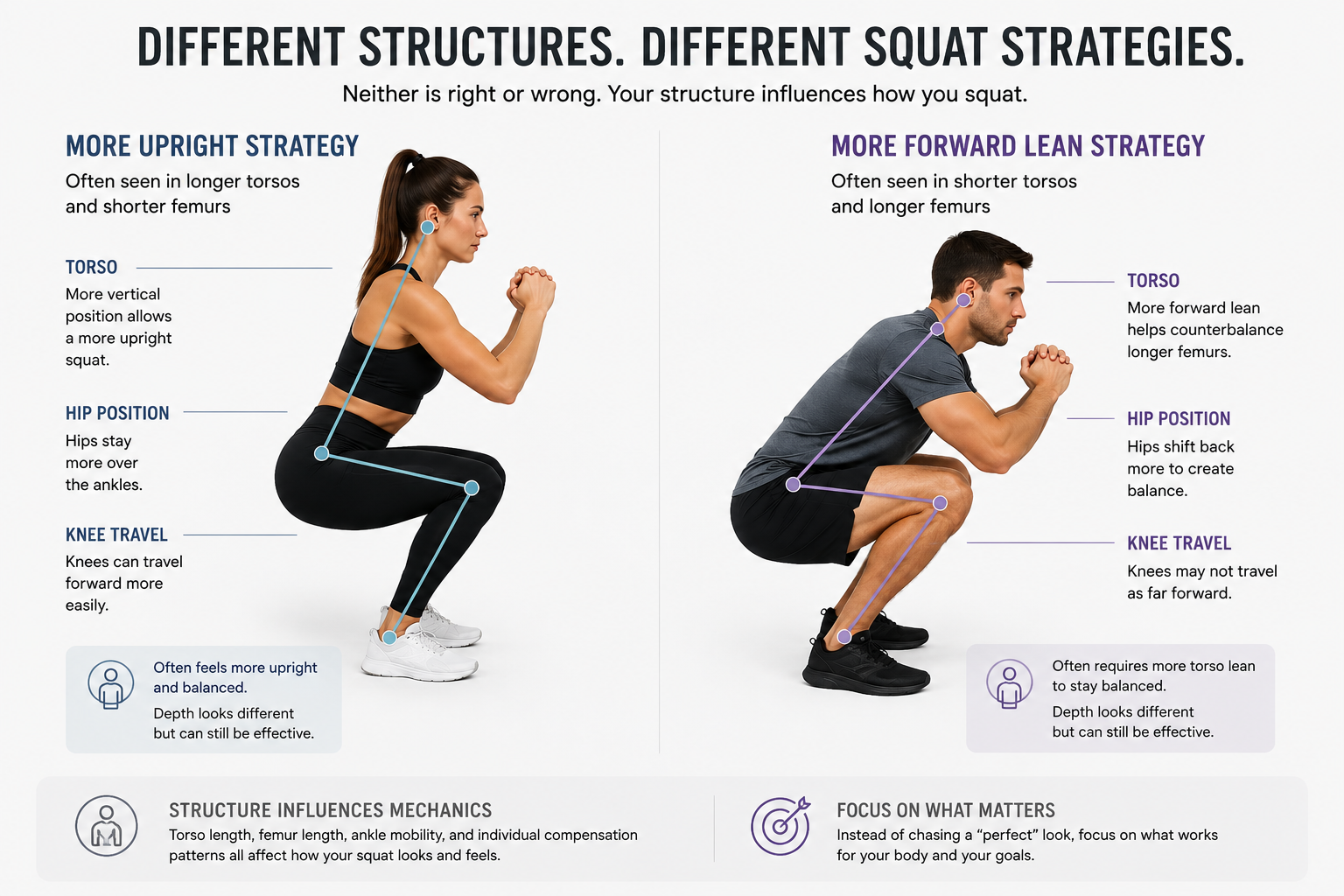
Some people naturally stay more upright when they squat, while others lean forward more because of their structure.
Things like femur length, torso proportions, hip shape, stance width, and squat depth all change the lever arms your body has to manage during movement.
The longer the lever arm, the more demand that area usually has to control. So for someone with longer femurs and a shorter torso, a more forward lean may not mean they’re doing it wrong—it may simply be how their body stays balanced and distributes force.
For some people, a more upright squat feels natural. For others, a more forward lean is part of how their body produces force efficiently.
Research also shows there’s a wide range of natural movement variability among pain-free lifters and athletes. That means there isn’t one exact squat pattern everyone needs to force themselves into. Movement Variability and Lifting Strategies Study
Your squat doesn’t need to look identical to someone else’s to be safe or effective.
The important thing is finding a version that works well for your body and your goals.
Why I Had to Change My Own Squat
I’ve never been someone who felt comfortable squatting. There’s a reason people have always called me “baby giraffe.” I have long femurs and a short torso, which makes me lean forward more during a squat. For me, this often led to lower back strain rather than hip and glute stability.
At first, I simply widened my stance similar to a sumo squat, but I was never able to ‘feel’ my glutes working. So I narrowed my stance and tried counterbalancing with a weight. However, the weight I needed to hold was too heavy for me. Lifting my heels helped slightly, but something still felt off.
I started thinking it was my mobility, and even after doing all the drills… I still couldn’t squat! Finally, I realized it was more about coordination and my body’s structure!!!!
I couldn’t get my hips to sit back while letting my knees move forward in a controlled way. So instead of forcing depth, I made the movement simpler.
So, I used a box behind me as a hip target and limited my depth, sometimes using a foam roller instead. This helped me drive my knees forward with control.
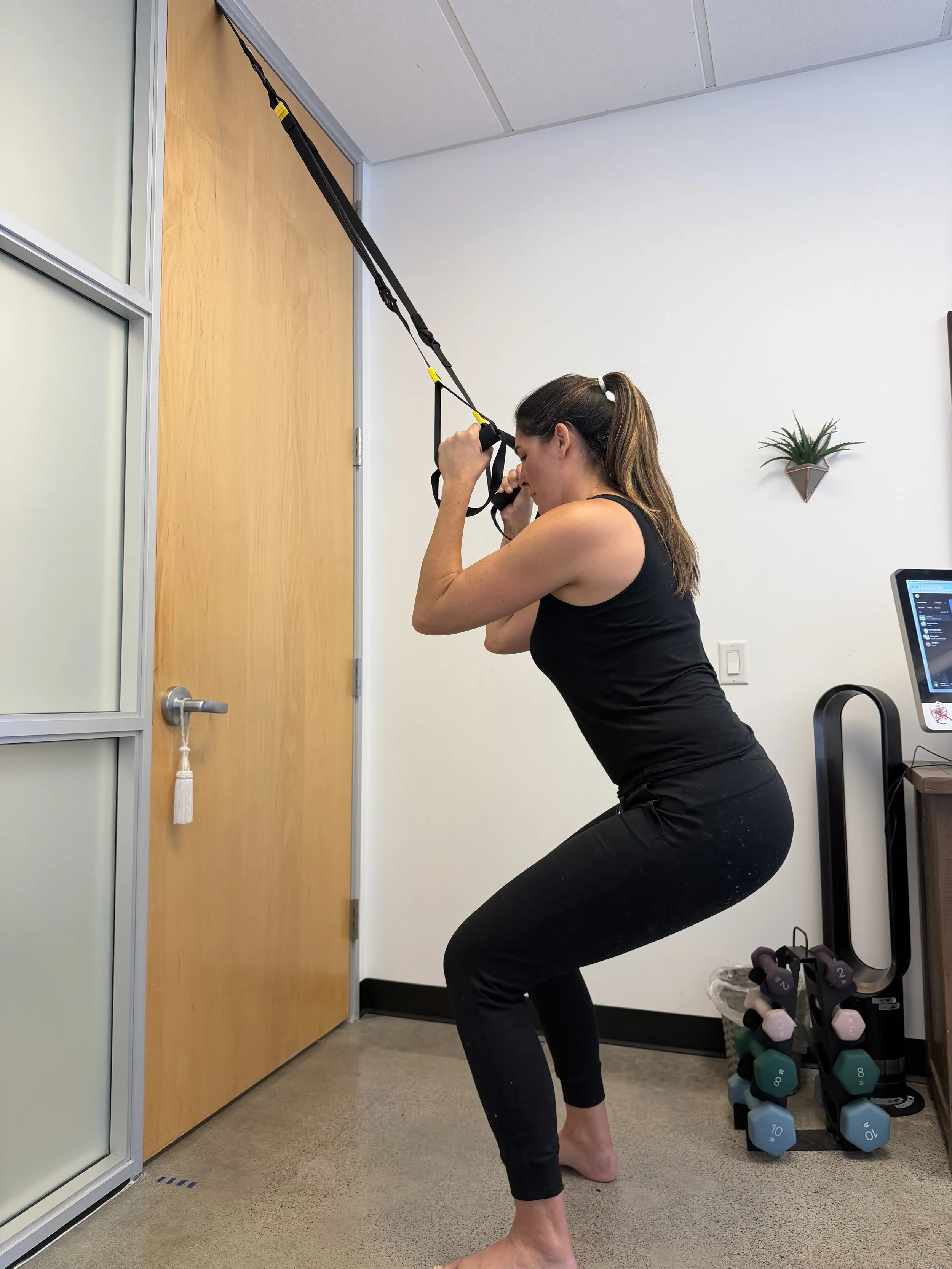
Once that got better, I noticed another issue—my ankles. They weren’t stable from my many years of rolling them during volleyball. I’m still working on this, so I found another workaround in the meantime by using a TRX strap for support when I wanted to reach a deeper depth—similar to how holding a weight in front of you can help counterbalance.
Over time, my squat has become less forced and more controlled. Not because I found some magic mobility drill… It was because I stopped trying to force a version my body wasn’t ready for yet.
Goals Matter Too
Not everyone needs the same squat.
Some people want to lift heavy for sport, strength training, or work. Others want to improve athletic performance, recover after injury, or simply stay active without pain and feel more confident moving again.
Those goals often require different approaches.
The best squat isn’t always the deepest, heaviest, or most “perfect” looking squat. It’s the version your body can currently perform safely and consistently to meet the demands you actually need it to.
And this is where many people get stuck.
They keep forcing mobility, depth, or positions their body may not actually need instead of improving the quality and control of the movement they already have.
That’s why stretching more or forcing depth doesn’t always solve the problem.
You Don’t Need to Be Afraid of the Movement
A lot of people stop squatting completely once pain starts because they’re afraid they’re damaging something.
But avoiding movement forever usually isn’t the answer. The goal is to rebuild tolerance slowly so your body can trust the movement again. You’re not removing the movemen… You’re adjusting the movement until your body can handle it better.
That’s a big difference. If you’re still feeling stuck between “This hurts,” and “I don’t know what my body actually needs…”
That’s exactly when assessment matters! You don’t need more random exercises.
You need to understand what your body is compensating for and what it’s currently prepared to handle.
Or if you want more breakdowns like this on movement, pain, recovery, and training. Follow along on Instagram & Facebook