
Road to Recovery or Circle of Death…Is Foam Rolling Good for You?
3 Surprising Reasons Foam Rolling Won't Fix Back Pain or Enhance Athletic Performance

Foam roller devotees swear by foam rolling and tout its benefits. There are those like me who believe grinding away on a foam roller is more of a band-aid because of the passive nature of the modality. While it might ease the pain, short-term, it doesn’t address the underlying cause of pain because usually… that is much deeper.
So, what are the negative to foam rolling? And is there a better option?
During my initial consultation, I ask new clients an important question: What have they tried to help ease their pain?
More often than not, their answer includes foam rolling. It’s easy to see why people use them. I found thousands of YouTube videos and articles suggesting foam roller exercises to CORRECT POSTURE. There are plenty of gizmos advertised that are excellent at TREATING NECK PAIN. Social media is constantly abuzz with pro-foam roller posts in exercise groups.
Its proponents claim it can relieve pain, aid recovery, increase flexibility, and correct posture. Could foam rolling be the panacea that we are all looking for? But does foam rolling actually help with pain or enhance athletic performance? It turns out foam rolling is a polarizing topic.
First, we have to answer the question: where did the pain come from? I could write a novel on the varied potential reasons, but the short and sweet of it is: it’s how we move. If you move asymmetrically, there’s a higher possibility you’ll eventually experience pain, but if your movement is symmetrical, it’s likely you won’t have pain. Movement and body position are key to enhancing athletic performance and staying pain-free. So for a foam roller to help reduce pain, it would have to change how we move… but we know that grinding away on a piece of foam can’t do that. One of my mentors, Tom Myers, once said:
“You can manipulate the tissue all you want. You can loosen it, make it more relaxed, whatever, but manually manipulating it can’t train it. Now you CAN train the tissue properly to fix pain and not manually manipulate it, but it’s a hell of a lot harder.”
Find more info about “Posture Faux-Pas” in our blog post “Good Posture & You.”
TRANSLATION
You DON’T need manual therapy (e.g. passive foam rolling) to get out of pain, but you DO need to change how you move. Manual therapy may help make training easier, but the root of the issue is your own movement.
Everyone seems to have their anecdote about foam rollers, but what does the research say?
To find out, I looked at the current research to check the validity of these wondrous claims. I looked at the data to see what benefits, if any, foam rollers could provide. The results may come as a surprise to many. After reviewing the research, the answer was clear: I found no data suggesting foam rolling is effective for reducing pain, in the long term.
FOAM ROLLER RESEARCH: Is foam rolling scientifically proven?
What I did find is that foam rolling can be useful to help mask certain issues. Meta-analysis of a variety of studies (Cheatham et al1) suggests that it can help with short-term flexibility and recovery. Sounds great, right? In my professional opinion, it can be okay, but in reality, to be PAIN-FREE, we need to address the ROOT CAUSE, and that’s learning how to move more symmetrical and more functional.
Additionally, foam rolling may make you feel better in the short term, but it doesn’t help with lactic acid buildup, and the underlying issue remains.
So what can people do for pain if foam rollers aren’t the magic cure-all that so many people say they are? Luckily, there are healthy alternatives that may provide people with better results!
HEALTHY ALTERNATIVES
There is a reason why I call them “circles of death”, despite offering short-term relief. Why? They don’t address the cause and give people a false sense of progress and well-being. In some cases, they can even exacerbate the issue. I always focus on treating the cause, not the symptom. But when immediate relief is needed, there are many better alternatives to foam rolling.
FOAM ROLLER: NOT THIS, BUT THAT
HERE ARE MY 3 REASONS WHY WE ENCOURAGE CLIENTS TO NOT RELY ON FOAM ROLLERS AS A CRUTCH AND MY ALTERNATIVES.
Foam roller pain
Tight, Stiff, and Weak Muscles
Improper Usage
Read on to see what you can do instead of using a foam roller!
1. FOAM ROLLERS ARE PAINFUL!
Even during a massage, there is such a fine line between “Ahhhhh” and “Ouch!” I can’t stress enough that the “no pain, no gain " mentality isn’t beneficial, and the same goes for the foam roller. I’ve watched people grimace, hold their breath, tense up as they grind away. As you are trying to “loosen the muscles naturally,” you are actually tensing your muscles.
The pain can also be a sign that you’re causing more damage. People can often push too hard on the roller, coming away with bruises and muscle strain. This should be a clear sign to back off. Sometimes your knee pain or IT band will feel better after a hard rolling of the quads. But it’s not because foam rolling fixed the problem. It’s because you’ve numbed those areas and now have pain elsewhere that your brain is focusing on. Deep pressure needs to be applied gradually and in the right direction to achieve therapeutic results. Rolling over a piece of foam won’t cut it.
FIX FOAM ROLLER PAIN!
Foam rolling and massage therapy primarily target surface-level muscles and may not effectively address deep fascial imbalances because they don't penetrate deeply enough into the body's tissues. These imbalances often extend beyond isolated areas and can involve interconnected muscles and fascia throughout the body. Therefore, a more holistic approach is needed to address these issues comprehensively.
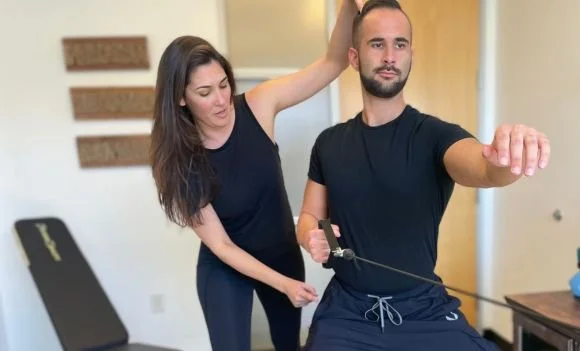
In contrast, a 1-on-1 training session is a more well-rounded solution. Through a combination of strength training, flexibility exercises, and targeted movements, these classes can help improve overall body alignment, muscle balance, and mobility. I address with my clients participants their deeper fascial imbalances while also enjoying the supportive and motivating environment.
2. TIGHT MUSCLES, STIFF MUSCLES, AND WEAK MUSCLES
Often, the muscle group that is in pain is loose, weak, and overused. These are the muscles people focus on rolling. If you’re loosening a muscle that’s already loose with a foam roller, you are compounding the problem!
TEST DON’T GUESS!
Before reaching for a foam roller to “loosen” your hamstrings, you need to understand what’s actually going on.
A simple way to assess this is with the Straight Leg Raise (SLR) test, which looks at hamstring mobility and how your nervous system is tolerating tension. Here’s how to do it:
Lie flat on your back
Keep one leg straight on the ground
Lift the other leg up, keeping the knee straight
Stop when you feel tension—not pain
Take note of the angle and compare both sides
👉 Most people should be able to reach about 70–90° without significant restriction.
If you feel a strong stretch early, asymmetry between sides, or discomfort, your hamstrings may not actually be “tight”—they may be overloaded, compensating, or lacking proper control.
That means more rolling isn’t the answer.
3. IMPROPER USAGE OF THE TOOL

This is a big one.
I once read an article titled “Tips to Unlock Your Lower Back.”Naturally, I was curious. But when I looked closer, it was full of examples of improper foam roller use—especially when targeting the hamstrings.
What I saw was people:

Supporting their entire body weight through their shoulders (Image 1)
Locking out (hyperextending) the knee, crushing through the calf and hamstring without control (Image 2)
This puts the body in a compromised position and often creates more tension, not less.
Think about it—no coach would ever tell you to lift weights with poor form. So why would we accept poor form during recovery?
👉 If the position is bad, the outcome will be too. Instead, try this (target the right area)

If you actually want to address your hamstrings, where you apply pressure matters.
Yes—there are times when the belly of the hamstring may need attention. But if that’s the case, your best option is hands-on work like massage therapy, where pressure can be applied gradually and with control.
If that’s not accessible, you can still get meaningful results by targeting the attachment point at the gluteal fold—without putting your body in a compromised position.
Most people default to rolling the middle of the muscle, but the issue is often closer to where the hamstrings meet the pelvis.
How to do it:
Place a softball-sized ball at the gluteal fold (just under your sit bone)
Extend the working leg with a slight bend in the knee
Use your hands for support so you’re not dumping all your weight into the ball
👉 This allows you to apply pressure more precisely while staying in a safe, controlled position.
IN CONCLUSION
Foam rolling’s benefits are limited at best. While it may provide short-term relief, it doesn’t address the root cause of pain. Pain is often a result of how you move—and lasting change comes from improving movement, not just trying to “loosen” tissue.
If you’re relying on foam rolling to fix pain, you may be missing the bigger picture.
You don’t need to put your body in painful or compromising positions to feel better. There are more effective, sustainable ways to reduce pain and improve performance.
👉 Recovery is only one piece of the puzzle—but strength alone isn’t the full answer either.
Your body needs both the ability to move well and the capacity to handle load.
If you want to understand why strength training by itself isn’t enough—and what actually creates lasting results—check out my post on why strength training alone won’t fix pain.
If you’re trying to stay active without constantly chasing pain or tightness, I share more practical tips like this on Instagram.