
Which Types of Workouts Give the Best Exercise: Barbells, Bands, or Body Weight?
Which types of workouts offer the best exercise? Let’s take a closer look at 3 types of exercise equipment: bands, barbells (and other free weights), and bodyweight. They all have their pros and cons, so which is right for you? The answer depends on your fitness and athletic goals. Are you looking to gain strength or to free yourself from pain? Are you getting back into shape or looking to improve your athletic performance? Which one of these types of workouts will get you the gains that you are looking for? I break each of them down and help show you the best exercise for YOUR fitness goals! I have some great example workouts for each below!
Still not sure which type of training is right for your body and your goals? An Initial Consultation can help identify where you’re starting and what type of training makes the most sense for you.
First, Let’s Talk About…Bands
In my opinion, they are most useful when your goal is injury recovery and building stability.
If you’re currently dealing with an injury, here’s how to approach recovery the right way → Recovery from Injury and the M.E.A.T. Method
When recovering from an injury—or trying to prevent one—bands are a great tool. As they stretch, they create increasing tension, which makes it easier to adjust or back off if something doesn’t feel right.
This variable resistance isn’t ideal for building maximal strength, but it works extremely well for recovery. With free weights or bodyweight training, the constant load can be harder to control and may aggravate an injury if you push too far. Bands allow you to safely load and unload tension throughout the movement.
Bands also help engage stabilizer muscles with each movement. Studies have shown that resistance bands increase activation of stabilizer muscles, helping improve joint control and overall movement quality.
Improving stabilization helps reduce joint compression, improve movement control, and reinforce proper form as you progress. Over time, this allows you to train with more control, reduce unnecessary wear and tear, and build a stronger foundation for higher-level training.
Versatile And Can Be Used Almost Anywhere
Because bands are compact and easy to pack, you can take them anywhere. This makes it easier to stay consistent with your workouts or recovery, even when traveling.
Bands are also highly versatile for targeted training. You can use them in multiple ways to work the same muscle group, which helps keep workouts effective and prevents your body from adapting to a single movement pattern.
As your body adapts to a specific exercise, it gets less out of it over time. Bands allow you to change the line of motion and challenge your muscles in different ways, helping reduce overuse and unnecessary stress on your joints.
Cons Of Using Bands
While bands are great for rehabilitation, they do have some drawbacks. Bands have max resistance at full extension. This also means they offer no resistance when not stretched. This non-constant resistance is good for recovery but not ideal for building muscle mass. Bands don’t allow you to load your muscles at the start of a movement. When building strength, you want to maintain the load through the entire range of motion. Bands also wear out over time. They lose their elasticity over time and can even break if overused. You may not get the same amount of tension on the muscle throughout the band's lifetime. When using bands, some exercises also require a mounting surface, such as a door or a pole. This can limit the types of exercises you can do if your mounting options are limited.
To summarize, Bands are great for recovery and post-recovery exercises. They are perfect for strengthening and recovering muscles or joints and preventing future injury. When used alongside sports massage and other recovery techniques (which we offer! 🙂), bands help you recover quickly and efficiently. I highly recommend them for people in recovery or those getting back into an exercise routine.
Pro-Tips When Using Bands:
FOCUS ON CONTROLLING YOUR MOVEMENT throughout the range of motion. Slow and steady movements with good form are key. If you find yourself wobbling or unable to reach the full range of motion, try a lower-resistance band.
Depending on how often you use your bands, it’s recommended you REPLACE YOUR BANDS EVERY ~6 MONTHS. Because they are essentially giant rubber bands, they, unfortunately, break down. Over time, the bands lose their elasticity and must be replaced.
It’s important to USE A VARIETY OF BANDS WITH DIFFERENT AMOUNTS OF RESISTANCE, such as these. There isn’t a one-size-fits-all exercise band; different muscle groups need different levels of resistance. Having many bands will allow you to target multiple muscle groups. It also allows you to increase the resistance as you grow stronger. Bands with handles or leg straps also allow you to go through your full range of motion more smoothly.
Next, Let’s Take A Look At… Barbells (free weights)
If your goal is to build strength and muscle mass (hypertrophy), free weights are one of the most effective tools.
They’re a valuable part of any strength training program, no matter your experience level or goals. You don’t have to be the next bodybuilder to benefit—building muscle supports bone density, metabolism, and overall strength.
Free Weights Give Constant Resistance
Free weights allow you to mimic real-life movement patterns with added resistance. Unlike bands, they provide a constant load through gravity, maintaining tension on your muscles throughout the entire range of motion—such as at the bottom of a preacher curl. While the weight itself stays the same, how it loads your body changes based on your position and movement. Think of a bench press versus pressing weight while standing—same motion, but different demands on your body. This is important to keep in mind as you train.
One major benefit of constant load is the ability to track and progressively overload your exercises. Progressive overload is key for building strength, and free weights make it easy to establish a baseline and gradually increase resistance over time.
Work Those Stabilizers!
Free weights also challenge your stabilizer muscles. Because the weights are “free,” your body must control and balance them throughout the movement. The primary muscles create the movement, while stabilizers help guide and control it—leading to improved coordination and overall strength.
Building muscle mass also supports fat loss. Muscle requires energy to maintain, which increases your overall metabolism. When combined with a healthy diet, this can help your body use stored energy more efficiently—even outside workouts.
Free weights are also durable and long-lasting. With proper care, they can be used for years without needing replacement
Cons For Barbells (Free Weights)
Free weights do come with some trade-offs. As the weight increases, so does the demand on your body—and the risk of injury if not managed properly. Being conservative when increasing load and maintaining good form is key.
Because the weights are not fixed, there’s also a higher risk if you fail a rep or lose control. This is where a spotter can be helpful, especially when lifting heavier loads.
Free weights are also less convenient. They aren’t travel-friendly, and building a full setup can be expensive. For most people, access to a gym is the easiest way to use them consistently.
Pro-Tips When Using Barbells (And Other Free Weights):
Like bands, MAKE SURE YOU ARE USING CONTROLLED MOVEMENTS. It’s easy to swing weights and let momentum do the work for you. This not only robs your muscles of gains but also puts you at risk of serious injury. If you can’t maintain good form while lifting, you are lifting too heavy! Grab a lighter weight and use controlled motion–your muscles and joints will thank you!
FOCUS ON THE MUSCLES YOU ARE TRYING TO WORK WITH A SPECIFIC EXERCISE. It’s easy to engage other muscles to help you lift the weight if you are not paying attention. For example, people often engage their biceps when trying to do a seated lat pull-down. When done correctly, this exercise targets your latissimus dorsi, or “lats”. By allowing your biceps to take some of the load, you are robbing gains from your lats! If you find this happening, it often means you need to use less weight. It can also be a problem with your form or a poor mind-body connection. To fix these issues, I have the perfect video here!
If you are lifting heavy, MAKE SURE YOU HAVE A SPOTTER! Leave your ego at the door! A spotter helps you push yourself without risking injury. Anyone can spot, but not everyone knows how to do it right! It’s important to make sure that your spotter knows what they are doing. They need to be strong enough to lift the weight if you fail your rep. Also, make sure that your spotter doesn’t lift the weight for you or yank it out of your hands if you start to struggle. Your spotter is there to give you a little help. They should only do enough to increase their weight without injuring themselves. They shouldn’t be lifting the weight for you.
And Now, Let’s Discuss…Bodyweight training
Bodyweight training is most useful when your goal is to build flexibility or to start a new workout routine.
Building a Strong Foundation First. Bodyweight training is most useful when your goal is to build control, improve flexibility, or create a strong foundation before adding load.
If you’re starting a new routine or coming back from injury, this is often the best place to begin.
If this sounds familiar, this is exactly why pain tends to keep coming back → Why Lower Back Pain Keeps Coming Back
Bodyweight training is where a lot of people should start—but often don’t.
It gives you a chance to focus on how your body actually moves before adding more weight or complexity. That’s where you build control, coordination, and awareness—what we call your mind-body connection.
The problem is, most people skip this step. They jump straight into heavier training, lose control of their movement, and start building compensation patterns that eventually lead to pain or injury.
Bodyweight training helps you slow things down, clean things up, and build a foundation your body can actually support.
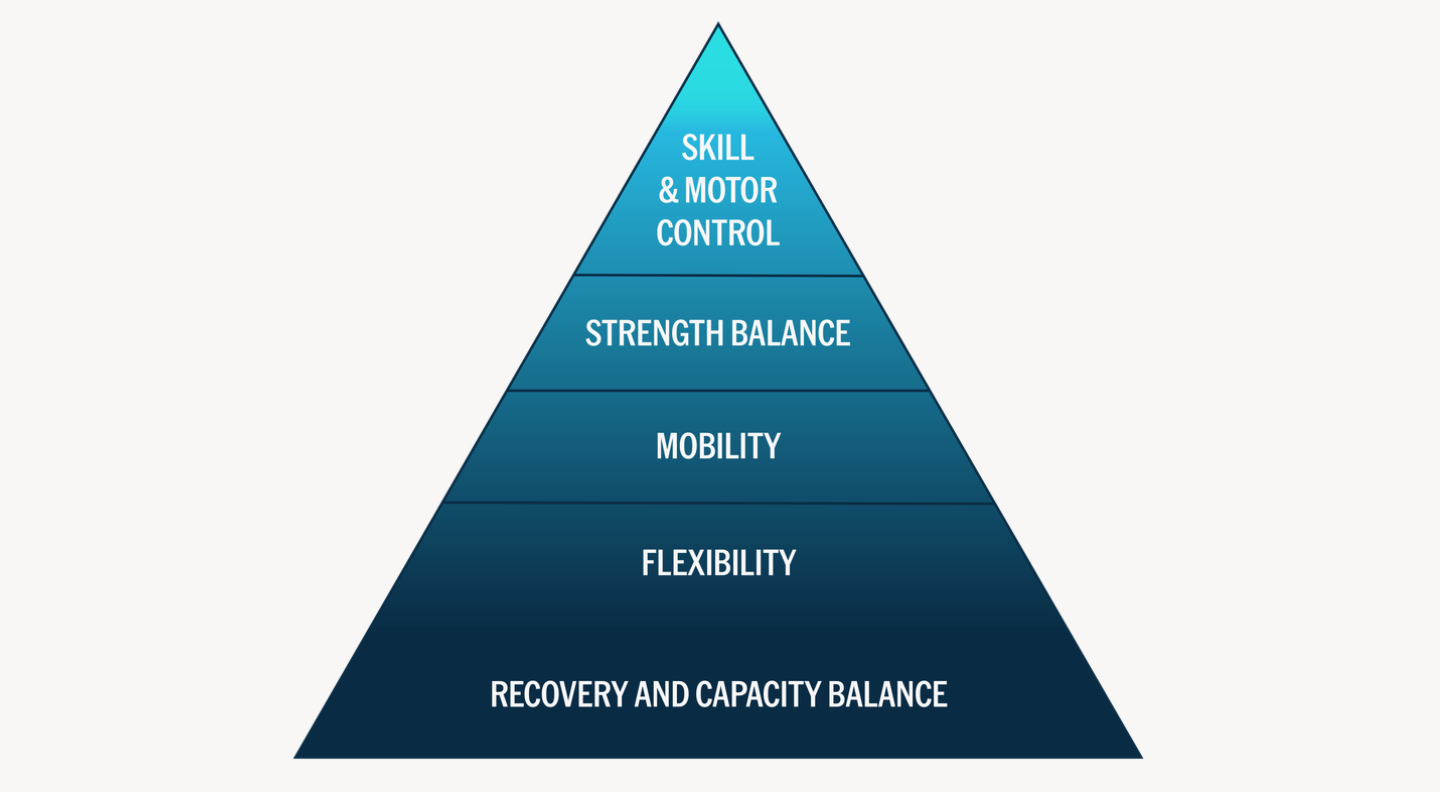
Instead of thinking of exercises as separate tools, it’s more helpful to view training as a progression.
Your body needs a base before it can handle higher levels of strength and performance.
It usually looks something like this: your body first needs enough recovery and capacity to handle stress, then you build flexibility, followed by mobility, then strength balance, and finally skill and motor control.
If one of those layers is missing, things don’t work the way they should. That’s when you start to notice tightness that keeps coming back, strength that doesn’t carry over into movement, or pain that shows up without a clear reason.
Bodyweight training plays a big role in building that base.
From there, you can start to layer things in—adding bands for stability and control, and eventually free weights for strength and load capacity.
Cons for Bodyweight
As you get stronger, bodyweight training can start to feel less challenging. Your body adapts, and without adding more load, progress can slow down.
It can also be harder to isolate specific muscle groups than with bands or free weights. Bodyweight work is great for full-body control, but it’s not always the best tool when you’re trying to target something more specific.
And if you’re already dealing with an injury, some positions may feel uncomfortable or even aggravate things depending on where you’re at.
That doesn’t mean bodyweight training isn’t useful—it just means it’s one piece of the process. As your body adapts, it often needs to be combined with other tools to keep progressing.
Pro-Tips When Using Bodyweight:
FOCUS ON IMPROVING YOUR FORM so that you don’t develop poor compensation patterns. Bodyweight exercises are great for taking it slow. You will develop a stronger mind-body connection and improve your body's movement. Improving your form is a huge help when you start to move up to higher resistance, such as with free weights or bands. Having the correct form means you can lift heavier while also reducing your risk of injury. Poor form can come from our everyday lives. Often it’s because we are too sedentary (anyone ever get tired of sitting at a desk all day?) Check out my 15-minute stretch video for tips on improving your body’s form!
CHANGE UP YOUR WORKOUT EVERY ONCE IN A WHILE. Increase or decrease the speed (keep it controlled!), change the number of reps, or mix up the range of motion. This will help challenge your muscles and also stimulate your mind-body connection.
WORK OUT WITH A PARTNER. A partner is great for checking your movements and helping you maintain your form. A workout partner can also help you mix things up. It’s easier to try new positions and forms when you have someone to give you feedback. This also helps ensure your workouts don’t get stale!
So, Which Is The Best Exercise For You?
Now that we have an overview of each exercise type, which is best? We know the pros and cons, but which exercise is best for you and your athletic goals?
It may come as no surprise, but the best programs include a combination of all three! A combination of barbells, bands, and bodyweight training gets you a well-rounded workout. This lets you maximize your gains and athletic ability. A great place to start is to try some new exercises in each category. Use a mix of bands for recovery, weights for strength, and bodyweight for form and flexibility! How much of each movement you use, and which ones, depend on your goals and fitness level. Are you going for pure strength? Recovering from an injury? Trying to gain flexibility? Your goal will help determine how you mix things up. But remember, using all three will help you optimize your training and gains!
Don’t Know Where To Start?
Most people don’t need more exercises—they need the right combination based on how their bodies move, recover, and handle load.
If you’re dealing with pain, coming back from injury, or not seeing progress despite doing “everything right,” there’s usually a missing piece. An Initial Consultation can help identify what’s limiting you and determine the best place to start.
Want more tips like this? I share practical training, recovery, and performance insights on Instagram.